


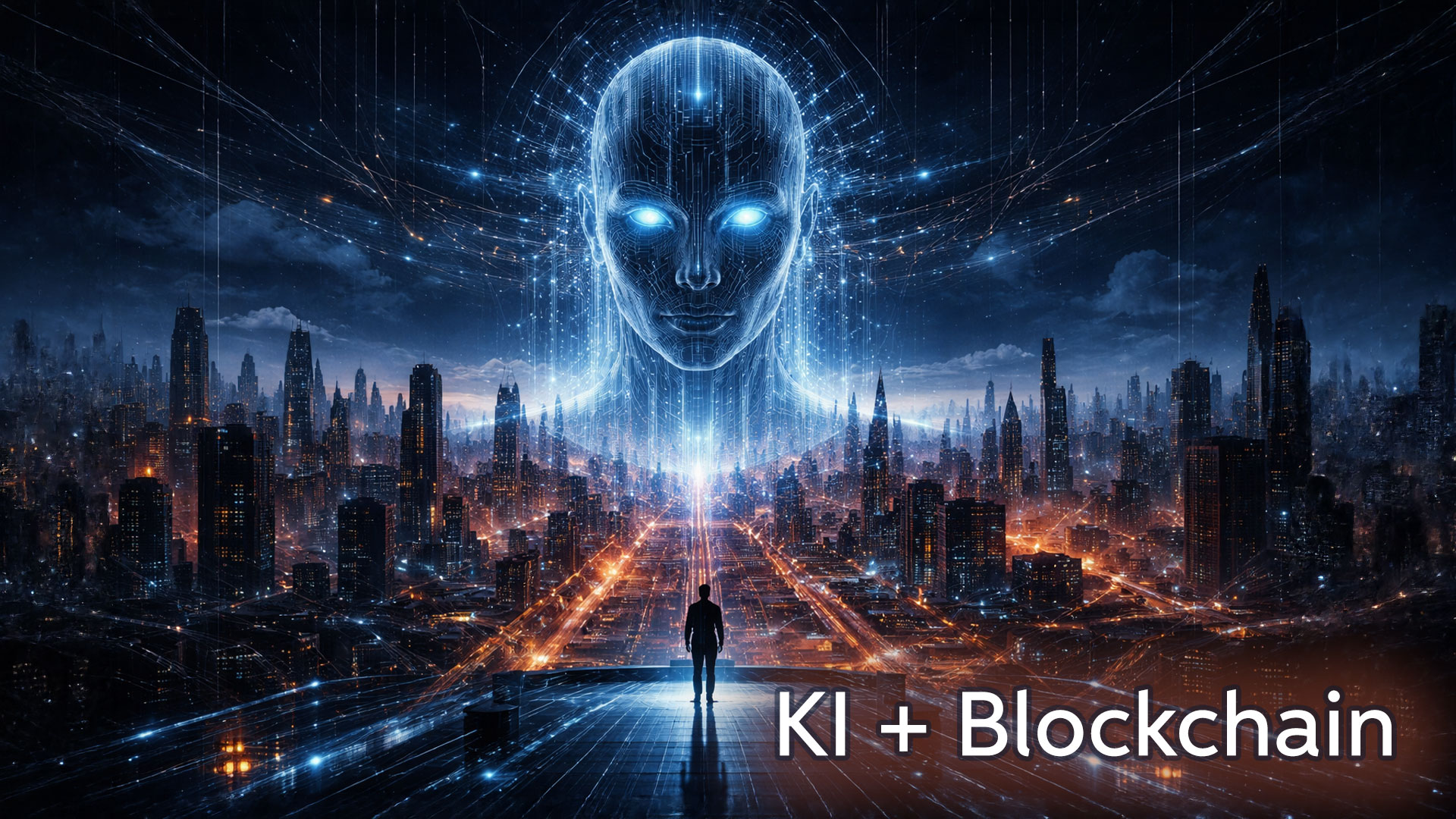
KI and Blockchain are considered the keys to a freer, decentralised world. But what if these technologies become the most perfect surveillance system in history — and we accept it voluntarily?
We Are Building Our Own Cage —
And Calling It Progress.
Imagine it's 2030. You want to take out a loan. No human reviews your application. An AI agent analyses your entire transaction history of the last ten years in milliseconds — immutably stored on the blockchain. Your result: rejected. Reason: your spending behaviour deviates from the profile of a "responsible borrower." Appeal? Not provided for. The algorithm has decided.
Does that sound like dystopian fiction? Perhaps. But the technological foundations for it already exist today — and they are being built out at a pace that hardly anyone truly understands.
What's happening right now
AI + Blockchain: The Marriage of Two Megatrends
Two of the most powerful technology movements of our time are growing together. Artificial intelligence is learning to make decisions independently. Blockchain records every step of those decisions immutably and visibly for all. At first glance, that sounds ideal.
At the centre of this connection are so-called AI agents: programmes that don't just carry out tasks, but act autonomously, close contracts, move funds and even commission other agents — all automatically, all documented on the blockchain. They no longer need human approval. They don't wait.
Why is this being hyped so much right now? Because it solves real problems: reducing bureaucracy, accelerating processes, cutting costs, creating trust where none exists. The economic incentive is enormous. Billions are flowing into this development. The question that gets too little attention is a different one.
The Promise
The Bright Side of the Coin
Let's hear the optimists first — because they have good arguments.
An economy in which AI agents operate on a blockchain basis could indeed be more transparent than anything we know today. No hidden transactions. No backroom deals. Everything traceable. On top of that: fewer human errors, because machines don't sleep, can't be bribed and know no arbitrariness. Smart contracts — automatically executing contracts on the blockchain — could enable new forms of fair collaboration, across borders, even without a shared language or mutual trust.
That sounds good. That sounds like progress. And that is precisely the problem.
The Shadow Side
What the Enthusiasm Overlooks
Every property that counts as an advantage has a flip side — and that flip side is dangerous.
Total traceability also means: total surveillance. An immutable blockchain doesn't just store what you bought — it stores when, where, how often and in what context. Combined with AI analysis, this produces a behavioural profile of previously unimaginable precision.
Less human control does not automatically mean better control. It means: decisions that affect your life — credit, insurance, job, access to services — are made by systems you cannot question, that know no exceptions and that cannot be held liable.
Efficiency sounds neutral. But: efficient for whom? In whose interest are these systems optimised? Who sets the parameters by which an AI agent makes "correct" decisions?
The combination of AI and blockchain can become the most powerful control infrastructure that has ever existed — precise, immutable, scalable. And entirely in the possession of someone most people will never meet.
The Decisive Questions
What We Must Ask — Before We Are No Longer Allowed To.
- Who controls the AI — and according to whose values was it trained?
- Who defines the rules embedded in smart contracts — and who can change them?
- What democratic oversight exists over automated systems that exercise economic power?
- What happens when you are excluded from such a system — and there is no alternative system?
- Is "decentralised" truly decentralised — or are we simply calling a new form of centralisation something different?
The Turning Point
The Real Problem Is Not Technology
Here is an uncomfortable truth: blockchain technology is neither good nor evil. AI is neither liberator nor dictator. Technology has no intentions. But the people who control it do.
The decisive question is not whether these systems exist — that can no longer be stopped. The question is: Who holds the key? Whose rules are coded? In whose interest are decisions automated?
If a small group of companies or governments controls the infrastructure on which a decentralised economy is built, then that economy is not decentralised. It is more centralised than anything before — because its power structures are invisible to most people.
This is where it is being decided right now, which direction we go: genuine freedom through distributed systems — or technocratic control in new clothing.
A Different Approach
What True Decentralisation Would Have to Mean
There are approaches that take this contradiction seriously. Systems designed from the ground up to distribute power rather than concentrate it — where no single party, no company and no government can set the rules alone.
The Infinity Economics ecosystem attempts exactly that: to create an infrastructure in which AI-driven processes and economic decisions are structurally protected against the abuse of power. Not through regulation from above, but through architecture from below. When the rules are anchored within the system itself and no one can change them unilaterally, the question of power shifts fundamentally.
Whether that succeeds is an open question. But it shows: there is a choice. The question is whether we make it consciously — or whether we let it be made for us.
The Uncomfortable Twist
Most People Will Say "Yes" — Voluntarily
What is truly alarming is not that bad actors could use these systems for control. What is alarming is that we will adopt them voluntarily — because they are convenient.
 Comfort beats freedom — time and again, throughout history.
Efficiency beats oversight — as long as it doesn't affect us directly.
Dependency creeps in — until opting out is no longer an option.
We have seen this before: with social media, with smartphones, with cloud services. Every time, we traded convenience for data — and mostly we didn't care, because the harm remained abstract. With AI agents on the blockchain, the damage will be more concrete. And it will be immutably documented.
If we don't question who holds control, we are building the most efficient control system in history — and calling it progress.
— Core thesis
In Closing
What if the next great freedom movement is the last one — because after that, no one has the power to start one?
Questioning technology is not technophobia. It is self-protection. The hype around AI and blockchain is real — but it does not replace political analysis, ethical discussion or a conscious decision about which systems we want.
True decentralisation does not mean there's a blockchain logo on the whitepaper. It means that no one — truly no one — can set the rules unilaterally. That is harder to build. It is less comfortable to use. And it is the only thing that makes the difference.
So: question who controls the AI. Question what "decentralised" truly means. And question yourselves — when did you last trade comfort for freedom?
Share this post if you believe the discussion needs to happen. And write in the comments: where do you see the greatest danger — and where the greatest opportunity?


