


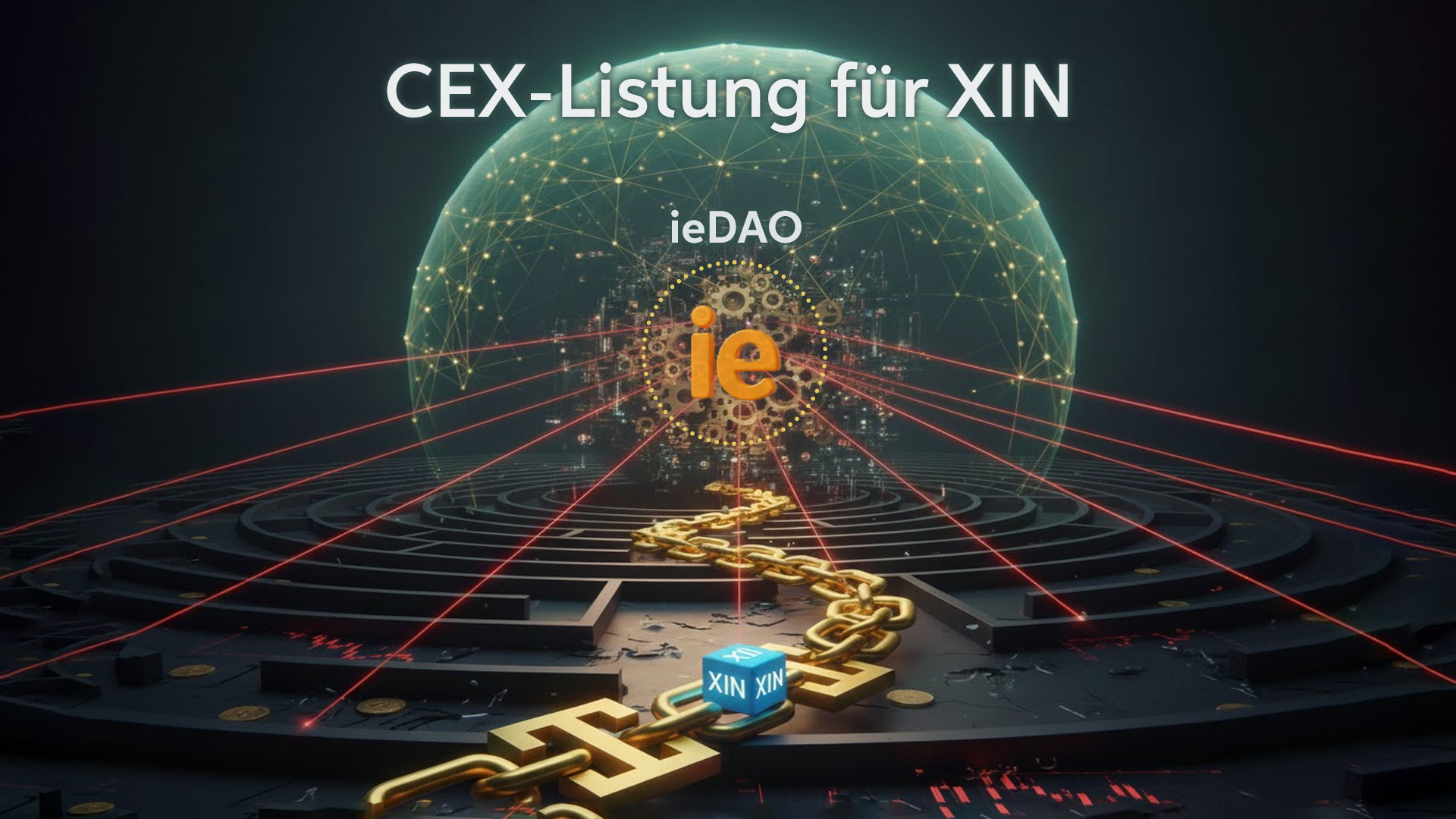
In the crypto world, listing on a major Centralized Exchange (CEX) is often seen as a "knighthood" for a project. Many investors and community members associate it with seriousness, liquidity, and, above all, rising prices. However, this perspective is narrow. An exchange listing is not a seal of quality, and certainly not a guarantee of sustainable success.
For XIN, as a native blockchain with DAO governance (Decentralized Autonomous Organization), the question of a CEX listing arises under very different circumstances than for short-lived marketing tokens. We must ask ourselves: Does this step serve the long-term vision of the ieCommunity, or does it currently jeopardize it?
What Does an Exchange Listing Actually Mean?
When we talk about listing on a CEX, we usually mean a spot listing. This means the coin can be traded directly against other currencies (such as USDT or Bitcoin).
The crucial point here is the custodial listing. Centralized exchanges function like traditional banks: if you hold XIN there, you do not own the private keys to your coins. The exchange manages them for you. This contradicts the core principle of self-sovereignty ("Not your keys, not your coins"). Technically, the exchange is merely a middleman maintaining an internal ledger. Only when you withdraw your coins to your own wallet does a real transaction take place on the blockchain.
The Advantages of a Listing – A Sober Look
There are certainly factual arguments in favor of a CEX:
Easy Access: Users do not have to deal with complex wallets or decentralized protocols. A login is sufficient.
Visibility: The project appears on the exchange's lists and is noticed by traders who previously had no connection to XIN.
Quick Tradability: Large volumes can often be transacted faster than in direct peer-to-peer trading.
However, these advantages primarily concern convenience and short-term trading activity. They say nothing about the intrinsic value or the technological stability of the project.
The Risks for a Native Blockchain Like XIN
For a project in the development phase, the dangers often outweigh the benefits. A listing creates massive market pressure. As soon as a coin is tradable, the market stares only at the price chart.
For native blockchains, the risk of a sell-off is particularly high if the listing occurs before genuine utility is established. Speculators who were only waiting for the listing news sell their holdings ("Sell the news"), which can lead to a price crash. For a young infrastructure like XIN, such an early loss of trust can have devastating consequences for its long-term reputation.
Market Makers: Artificial Liquidity and Its Pitfalls
Exchanges almost always require cooperation with a Market Maker for a listing. A Market Maker is a service provider that constantly places buy and sell orders in the order book to make the trading look "fluid."
The Problem: This liquidity is often artificial. If there are no real buyers, the Market Maker only keeps the price artificially stable.
Danger during Downtrends: In a real sell-off, Market Makers can even accelerate the withdrawal of capital or distort price discovery.
False Signals: High trading volumes suggest interest in the project that may not yet exist organically.
Market Makers are not philanthropists; they primarily secure their own profitability.
The Actual Interests of Exchanges
It is important to understand that an exchange is not a partner for project development. Exchanges are profit-oriented companies. Their main interests lie in:
Trading Fees: The more movement, the more the exchange earns. Whether the price rises or falls is secondary to the exchange.
Volume: Exchanges want projects that create "noise" to attract new users to their platform.
A stable, healthily growing project is often less attractive to an exchange than a highly volatile coin that allows them to earn through constant back-and-forth trading.
Reputational Risks for the IE Ecosystem
A premature or unstable listing has long-lasting effects. If XIN is listed on an exchange and fails there due to lack of liquidity or massive sell-offs, this "stain" remains visible in the charts for years.
This not only damages the trust of potential partners but also complicates future endeavors—such as building an independent, decentralized ieExchange. A false start is difficult to correct. Controlled growth within the protected framework of the community is often more valuable than an uncontrolled leap into the open market.
The Hidden Costs
A listing is expensive. In addition to the pure listing fees, which often reach six-figure sums, there are ongoing costs for Market Makers and providing liquidity.
This capital is then tied up. It is no longer available for software development, blockchain security, or building real-world use cases. We must ask ourselves: Is it more sensible to spend 200,000 francs on exchange fees or to invest this money in the technological infrastructure?
The Fallacy: "Exchange First, Users Later"
Many projects suffer from a fundamental error. They believe that users will come once the coin is listed on an exchange. In reality, it is the other way around: Usage must come first, then the exchange follows.
A comparison: When you open a shop, you first build the assortment and ensure that customers come because they need the goods. An exchange listing without existing usage is like renting a giant billboard on the highway, but your shop is still empty and has no cash register. People come once, see the emptiness, and never return.
Alternatives: Organic Growth and DEX
There are paths away from the large centralized exchanges:
DEX (Decentralized Exchanges): Here, users retain control over their keys. Trading takes place via smart contracts. It is fairer but technically more demanding.
Peer-to-Peer (P2P): Direct exchange within the community strengthens cohesion and self-responsibility.
Organic Usage: XIN should circulate through real applications within the ecosystem. When the coin has utility (e.g., for fees, governance, or services), value is created from within.
Conclusion
A CEX listing at this stage carries significant risks with little sustainable benefit. The danger of price manipulation, high costs, and a loss of control over the roadmap is real.
For XIN and the ieCommunity, it is more important to build a stable foundation. True decentralization and self-responsibility do not need a "go-ahead" from a centralized trading platform. Patience here is not a sign of weakness, but of strategic foresight. Once the usage of XIN has grown organically, the market will follow on its own—on our terms.


